
Table of Contents
- Why Solo Work Demands an Extra Set of Hands
- Solo Construction Safety Tips for Working Alone
- OSHA Lone Worker Safety Standards: What You Need to Know
- Best Tools for Securing Trailer Loads When You're on Your Own
- DIY vs Professional Grade: Choosing the Right Extra Set of Hands
- Ergonomic Strain Prevention and Improvised Jigs for Solo Workers
- Frequently Asked Questions
Last Updated: September 21, 2026
Why Solo Work Demands an Extra Set of Hands
Working alone is the norm on many job sites, not the exception. According to the Bureau of Labor Statistics' census of fatal occupational injuries, transportation incidents remain the leading cause of work-related deaths in the trades, and a large share of those happen when no one is around to spot a problem.
- You lose your spotter when you work alone
- You lose your second pair of hands on every lift and tie-down
- You gain time pressure, which is when mistakes happen
Solo Construction Safety Tips for Working Alone
Solo construction safety tips start with one rule: assume no one is coming to help. Plan every task as if you are the only person on site, because you are.
A few habits that experienced lone workers swear by:
- Tell someone your schedule and check in when you finish
- Keep your phone charged and within reach, not in the truck
- Set a hard stop time for any task that needs two people
- Never stand under a raised load, even briefly
- Stage materials so you never have to reach across an open trailer
OSHA Lone Worker Safety Standards: What You Need to Know
There is no single OSHA standard written only for lone workers. Instead, the general duty clause and several industry rules apply to anyone working alone.
The rules that actually apply when you are alone
- General duty clause (Section 5(a)(1)): Your workplace must be free of recognized hazards likely to cause death or serious harm. Working alone near a raised load or an unsecured trailer is a recognized hazard.
- Load securement (49 CFR Part 393, Subpart I): The Federal Motor Carrier Safety Administration sets the working load limits and tie-down counts for cargo on commercial vehicles. One person still has to meet the same tie-down count, alone does not mean fewer straps.
- Fall protection (29 CFR 1926 Subpart M): For construction work at 6 feet or more, fall protection is required regardless of crew size. A solo worker on a roof or scaffold has no one to catch a fall.
- Lockout/tagout (29 CFR 1910.147): If you service equipment alone, you are the only person who can verify the energy is isolated. There is no second set of eyes.
What a lone-worker program looks like in practice
A common pattern among safety-conscious solo operators is a written check-in plan. It does not need to be long. It needs to answer four questions:
- Who knows where you are? Name a specific person, not "someone." A spouse, a dispatcher, or a foreman.
- How often do you check in? Every two hours is a common interval for field work. Shorter for high-risk tasks.
- What triggers a response? A missed check-in by 30 minutes is a common trigger. The contact calls you, then calls the site, then calls emergency services.
- How do you call for help? Cell signal is not guaranteed. A satellite messenger or a personal locator beacon covers the gaps.
Documentation you can actually keep up with
You do not need a binder. A phone note or a laminated card in the truck works. Record the date, the task, the hazards you identified, and the controls you used. This does two things: it forces the pre-task thinking, and it gives you a record if an inspector or an insurer ever asks how you manage risk alone.
Best Tools for Securing Trailer Loads When You're on Your Own
The best tools for securing trailer loads when you are alone are the ones that hold position while you work. A strap that stays put is worth more than a strap that is stronger but keeps slipping.
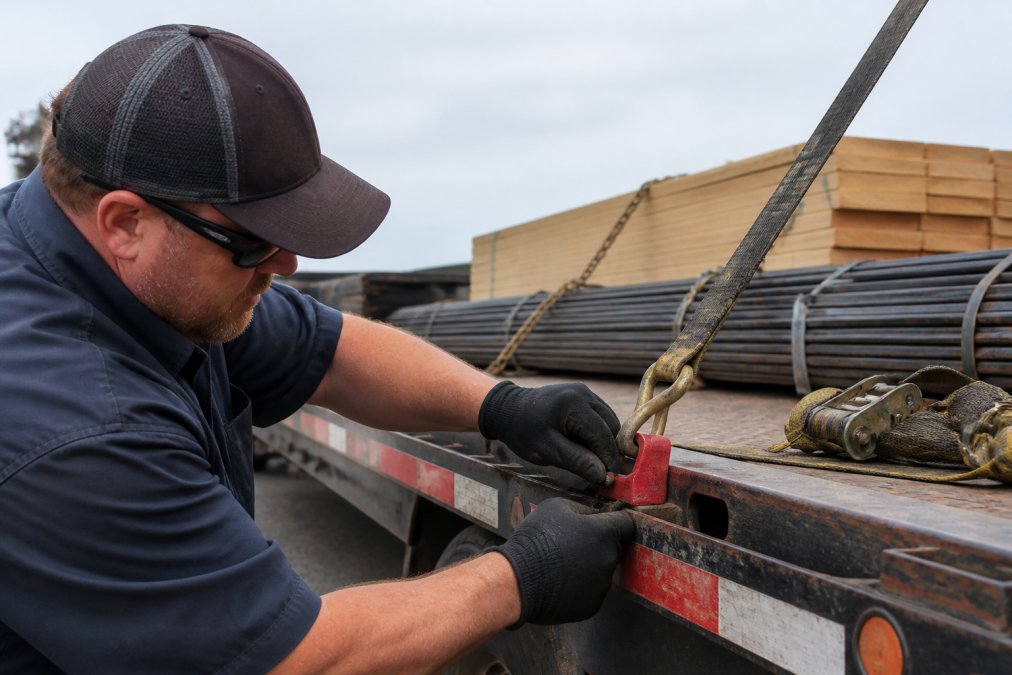
A quick look at what matters when you shop:
| Tool Type | What It Does | Best For |
|---|---|---|
| Magnetic strap holder | Holds hooks in place while you tension | Solo haulers, one-person loads |
| Spring clamps | Grip edges and thin materials | Light holding, layout work |
| Construction jack | Lifts and levels heavy panels | Drywall, doors, cabinets |
| Ratchet strap | Tensions and locks the load | Every secured load |
DIY vs Professional Grade: Choosing the Right Extra Set of Hands
DIY-grade tools work fine for weekend loads. Professional-grade tools cost more because they survive daily abuse.
Here is how to decide:
- Haul a few times a year: DIY-grade is fine, buy quality straps
- Haul weekly: step up to pro-grade holders and clamps
- Haul daily for work: buy the best you can afford, then replace worn parts
Ergonomic Strain Prevention and Improvised Jigs for Solo Workers
Most solo injuries do not come from one bad lift. They come from a hundred small ones: reaching across a trailer bed, twisting to grab a hook, bending to check a strap angle.
A few moves that help:
- Stage tools at waist height, not on the ground
- Use a magnetic holder so you do not chase hooks
- Turn your whole body, do not twist at the waist
- Take a 30-second reset between heavy tie-downs
What the strain actually costs you
A common pattern among tradespeople who work alone is that fatigue shows up as sloppy technique before it shows up as pain. When your grip fades, you stop checking strap angles. When your shoulders ache, you skip the second tie-down. The ergonomic problem and the safety problem are the same problem.
Three habits that pay off:
- Alternate hands on ratchet handles so one side is not doing all the work.
- Use your legs, not your back, when you tension a strap. Step into it.
- Set a timer for repetitive tasks. Every 20 minutes, stand up straight and reset your posture.
Improvised jigs and deadmen: the gap most guides skip
A deadman is any fixed point that holds a load while you work. Experienced tradespeople build them on the spot from scrap. The principle is simple: find something that will not move, and let it be your second hand.
Field-buildable deadmen and jigs:
- The 2x4 wedge: Cut a scrap of 2x4 to length and wedge it between a wall stud and the material you are holding. It holds a sheet of drywall or plywood at height while you fasten. Cost: nothing.
- The strap loop: Loop a ratchet strap around a trailer rail or a column and hook it back to itself. It becomes an anchor point for a load you are positioning alone.
- The magnetic holder as a jig: A magnetic strap holder on a steel frame holds a hook or a small part in place while you work with both hands. This is the same tool doing double duty as a positioning jig.
- The sawhorse-and-clamp bench: Two sawhorses and a pair of spring clamps turn any flat surface into a third hand for cutting and layout work.
- The door deadman: A length of 2x4 with a cleat screwed to one end, wedged under a door or panel, holds it at height while you shim and fasten.
DIY vs. professional grade: where the money goes
DIY-grade tools work fine for weekend loads. Professional-grade tools cost more because they survive daily abuse. The real difference comes down to how often you haul. If you move a boat twice a summer, a basic magnetic holder and a good set of ratchet straps will do the job. If you are on the road every week, you want gear that will not fail in the rain, cold, or dust.
Here is how to decide:
- Haul a few times a year: DIY-grade is fine, buy quality straps
- Haul weekly: step up to pro-grade holders and clamps
- Haul daily for work: buy the best you can afford, then replace worn parts
Frequently Asked Questions
Do construction workers need their own tools when working alone?
Yes, most construction workers need their own hand tools and safety gear when working alone. Employers often provide larger equipment, but personal tools like tape measures, levels, and securement devices are typically the worker's responsibility. Having the right tools, including an extra set of hands like a magnetic strap holder, helps you work efficiently and safely without relying on a partner. Check your employer's policy and OSHA guidelines for specific requirements.
What are the best tools for securing trailer loads when working solo?
The best tools for securing trailer loads include ratchet straps with flat, double J, or S hooks, bungee cords for lighter items, and magnetic strap holders that keep hooks in place while you tension the strap. A magnetic holder acts as an extra set of hands, so you don't have to walk back and forth across the trailer. Choose tools that match your load weight and hook type, and always inspect straps for wear before each use.
How do you safely secure construction materials when working alone?
Start by assessing the load and planning your tie-down points. Use mechanical aids like clamps, jigs, or magnetic holders to position straps without a partner. Follow OSHA lone worker safety standards by maintaining communication and having emergency check-ins. Secure materials with appropriate ratchet straps, ensuring hooks are firmly attached. For flat hooks, a magnetic strap holder provides that extra set of hands, preventing hooks from slipping while you tighten the strap.
What are the OSHA requirements for working alone in construction?
OSHA does not have a specific lone worker standard, but the General Duty Clause requires employers to provide a safe workplace. For solo construction, this means conducting risk assessments, providing training, and ensuring emergency communication. OSHA recommends check-in procedures and personal protective equipment. Always follow your company's lone worker policy and use tools that reduce manual strain, like an extra set of hands for securing loads, to minimize hazards.