
Quick Summary
Strap hooks stay in place when the hook matches the anchor, the strap is tensioned, and the hook is checked before you drive. Hooks usually slip because the fit is poor and vibration works them loose, so choose a hook shape that grips the anchor and confirm it sits flat under tension.
- Match the hook throat to the anchor; a flat hook on a round rail has little to grip.
- Double J hooks wrap rails and D-rings better than flat hooks.
- Magnetic holders keep steel-anchored hooks seated while you run the strap.
- Tape, zip ties and loops hold hooks during setup but do not carry the load.
- Pull the strap taut and recheck every hook after the first few miles.
Table of Contents
- Why Strap Hooks Keep Slipping Off Anchor Points
- Comparing Hook-Retention Methods: Tape, Zip Ties, Magnets and Loops
- How to Use Ratchet Straps with Hooks on Different Anchor Types
- How to Keep Ratchet Straps from Loosening During Transport
- How to Tie Down a Load with Ratchet Straps Safely
- Safety Limits and Inspection Checks for Hooks and Straps
- Storing Ratchet Straps and Hooks Between Hauls
- Keeping Hooks Put for Your Next Haul
- Frequently Asked Questions
Why Strap Hooks Keep Slipping Off Anchor Points
Strap hooks slip off anchor points more often than most haulers expect. A ratchet strap can look locked in one moment and be on the trailer floor the next, especially after the first bump on the road.
The usual cause is a poor fit between the hook and the anchor. A flat hook on a round rail has very little to grip.
Vibration makes things worse. Engine rumble, rough pavement and sudden braking all push the hook around. Loose strap webbing adds to the problem because slack lets the hook drop and shift before the strap is tensioned.
Wind is another common culprit. A hook that holds fine in a parking lot can lift away from its anchor on an open highway. Many haulers only notice the problem after the strap has already come loose.
Watch out: a hook that seems seated is not necessarily secure. Always pull the strap taut and check the hook before you move the vehicle.
Comparing Hook-Retention Methods: Tape, Zip Ties, Magnets and Loops
Several methods can hold a hook against an anchor while you set up the strap. They are not interchangeable, and none of them is a substitute for a properly tensioned strap.
A useful way to choose is to score each method on four things: how fast it is to apply and remove, how well it survives vibration and weather, whether it can damage the webbing or the anchor, and whether it works on the anchor you actually have. The table below summarizes those trade-offs.
| Method | Best For | Apply/Remove Speed | Vibration and Weather | Risk to Webbing or Anchor | Works On |
|---|---|---|---|---|---|
| Tape (duct or electrical) | Quick, temporary holds on smooth metal | Fast to apply, slow to clean | Poor in heat, cold, and wet; leaves residue | Adhesive residue can attract grit | Flat or rounded metal |
| Zip ties | Fixed steel anchors and rails | Moderate to apply, slow to remove | Good short-term, but UV degrades nylon | Over-tightening can crush or cut webbing | Rails, frames, D-rings |
| Magnets | Steel rails, frames, and bed sides | Fastest | Good on clean steel; fails on aluminum or rust | Can pinch webbing if placed carelessly | Ferrous metal only |
| Loops (webbing or cord) | Soft anchors, odd shapes, and stretchy points | Slow | Good if tied securely | Rubbing can fray webbing over time | Soft loops, D-rings, irregular anchors |
| Purpose-built hook retainers | Repeated setup on steel trailers | Fast | Designed for the job | Low if sized correctly | Depends on the retainer design |
Tape is the cheapest option and is easy to find.
Zip ties are sturdy and cheap. They can hold a hook to a rail, but they are hard to remove and they can cut into the strap if they are pulled too tight.
Magnets are the fastest method when the anchor is steel. This is where a tool like the StrapEaze magnetic strap hook holder fits in.
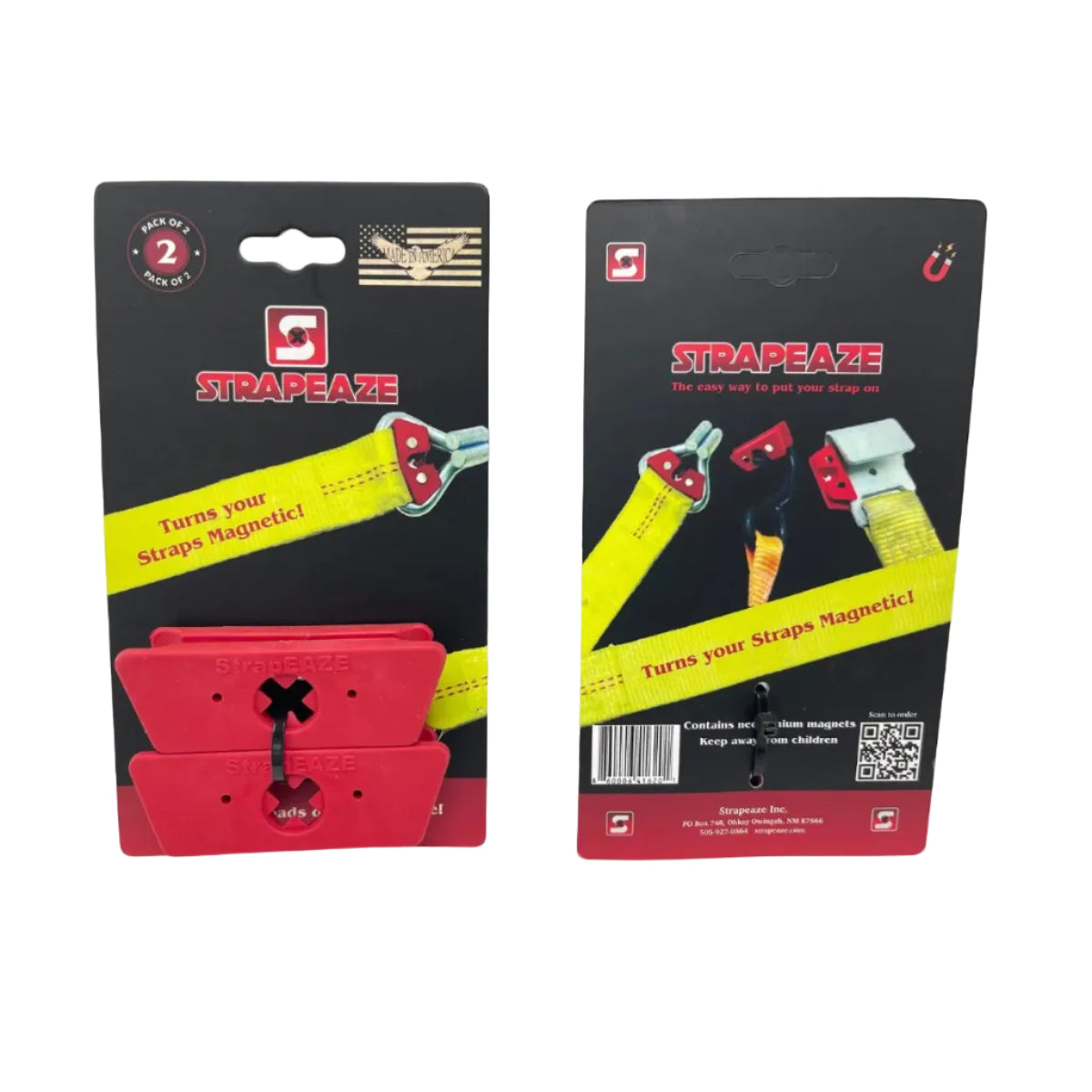
Loops work well for soft or stretchy anchors.
Watch out: tape, zip ties, magnets, and loops are retention aids, not load-bearing hardware.
Choose the method that fits your anchor and your schedule. For most steel trailers, a magnetic holder is the simplest. For soft or non-metal anchors, a loop is the practical choice.
How to Use Ratchet Straps with Hooks on Different Anchor Types
The right technique depends on the anchor, and most hook failures come from a mismatch between hook geometry and anchor geometry rather than from a bad strap. Before you tension anything, look at the hook throat opening, the hook point, and the anchor cross-section. If the throat is much wider than the anchor, the hook can rock. If the throat is narrower than the anchor, the hook will not seat at all. Match those two dimensions first, then choose the placement below.
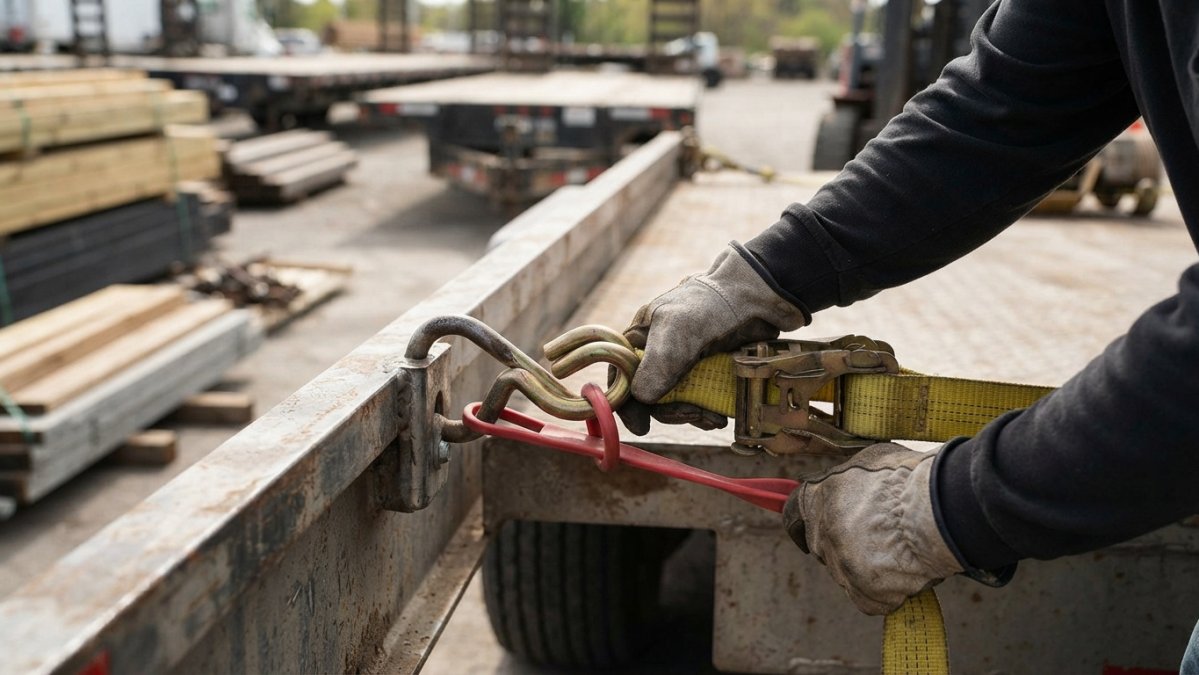
D-Rings and Soft Loops
D-rings are the most common anchor on trailers. Slide a double J hook or an S-hook through the ring so the hook's throat faces outward. This keeps the load pulling in the right direction. A hook that is much smaller than the ring will slide around the ring; a hook that is much larger will sit at an angle and load the tip instead of the throat.
Soft loops are sewn webbing anchors. Use a flat hook or a hook that fits through the loop without forcing it. Never hook a loop from the side, because the loop can fold and release under tension. If the hook throat is wider than the loop, the hook can slide off the loop's edge; in that case, pass the strap through the loop and back to itself, or switch to a hook with a narrower throat.
For both types, pull the strap taut and check that the hook sits flat against the anchor. A hook that is angled or twisted will slip first.
Truck Bed Rails and Trailer Anchors
Bed rails and trailer rails are round or rounded, so they need a hook that can grip the curve. A double J hook works best because its shape wraps around the rail. Place the hook so the point faces the load and the back of the hook rests on the rail.
Trailer anchors are often bolted to a frame and can be hard to reach. Set the hook first, then use a magnetic holder on the nearby steel to keep it there while you run the strap across the load. If the anchor is a welded loop or a punched hole rather than a ring, check that the hook point can pass through and that the throat seats on solid metal, not on the edge of the hole.
When the Hook Does Not Fit the Anchor
A hook that will not seat is a fit problem, not a technique problem. Common mismatches include a flat hook on a round rail, a double J hook on an oversized D-ring, an S-hook on a thin punched hole, and any hook on an anchor that is too thick for the throat. In those cases, do not force the hook or bend it. Instead, switch to a hook style that matches the anchor, add a soft loop or a short length of webbing as an adapter, or move to a different anchor point on the vehicle.
Watch out: a hook that has been bent to fit an anchor should be retired rather than reused.
Tip: work from one side at a time so the hooks stay within reach, and recheck every hook after the first few miles when the load has settled.
How to Keep Ratchet Straps from Loosening During Transport
A ratchet strap can loosen during the trip even when it was tight at the start. Vibration, cargo settling and temperature changes all play a role.
Start by tensioning the strap in stages. Tighten the ratchet, then check the load and tighten again. Cargo often settles in the first few miles, so a second check is important.
Keep the excess webbing under control. Loose tails can catch the wind or snag on something, which can pull the strap out of the ratchet. Coil the tail and secure it with a clip or tuck it under another strap.
Check the straps at every stop. Look at the hooks, the ratchet handle and the webbing. Tighten anything that has shifted.
Watch out: a strap that loosens over the first hour of a trip usually has a hook that moved, not a ratchet that failed. Re-seat the hook before you tighten again.
How to Tie Down a Load with Ratchet Straps Safely
A secure load depends on correct strap use, not just a tight hook. Follow these steps to tie down cargo safely.
- Place the load against the front of the trailer and block it so it cannot slide.
- Run the strap over the load and attach the first hook to a secure anchor.
- Take up the slack by hand before you touch the ratchet.
- Tighten the ratchet in short pulls until the strap is snug but not overstressed.
- Check the hook angle. The pull should run close to a 45-degree angle, not straight up.
- Repeat on the other side and recheck both hooks after a short drive.
Keep the ratchet handle clear of sharp edges and moving parts. Stand to the side of the strap, never in line with it, in case it releases.
Safety Limits and Inspection Checks for Hooks and Straps
Every strap has a working load limit, usually printed on the webbing or tag. Never exceed that limit, and never use a strap that is damaged.
Before each trip, inspect the webbing for cuts, fraying, burns or chemical damage. Check the hooks for cracks, bends or a worn throat. Replace any part that fails the check.
Inspect the ratchet for smooth operation. A ratchet that slips, clicks unevenly or will not hold tension should come out of service.
Watch out: a bent or stretched hook can look fine from a distance. Look closely at the throat and the tip before you rely on it.
Storing Ratchet Straps and Hooks Between Hauls
Good storage extends the life of your straps and hooks. Store them dry and out of direct sun, since long UV exposure weakens webbing over time.
Coil the straps loosely and hang them on a hook or peg. Keep hooks in a bin or on a rack so they do not tangle or dent. Store magnetic holders separately so they do not stick to metal shelving.
Wipe off dirt and road salt before storing. Grit and salt wear down webbing and can corrode metal parts.
Keeping Hooks Put for Your Next Haul
Strap hooks stay in place when you match the hook to the anchor, check the fit, keep the webbing managed and inspect the gear before each trip. A simple magnetic holder can take much of the hassle out of the setup, especially when you work alone. Make a quick check of every hook before you pull out, and you will spend less time chasing loose straps down the road.
Frequently Asked Questions
How do you secure ratchet strap hooks?
Seat the hook fully on a solid anchor point so the load pulls along the hook's curve rather than its tip. Use a hook sized to the anchor, then route the strap so it stays under slight tension. A hook-retention accessory such as a rubber hook holder can keep the hook in place while you walk to the other side of the bed. Check the hook after the first few miles, since vibration can shift it.
How do you keep ratchet strap hooks from slipping off?
Most slipping comes from a hook that sits on the wrong part of the anchor or from slack in the strap before tensioning. Confirm the hook bears on the solid metal, not a painted or flexible edge. Keep the pull angle close to a direct downward pull where possible. A rubber hook holder with magnets clasped to the truck bed or trailer rail can hold the hook steady until you finish tensioning, which is useful when you are working alone.
How do you tie down a load with ratchet straps?
Position each strap over the load and attach both hooks to secure anchor points on the vehicle. Take up slack by hand, then ratchet until the strap is snug. Keep the strap hooks seated and tensioned, and avoid overtightening, which can damage cargo or the anchor. Recheck tension after the first stop and again during the trip. A magnetic holder can keep hooks in place while you work alone.
How should you store ratchet straps?
Coil the strap loosely in a figure-eight pattern so it does not kink, and keep hooks clipped or tucked into the coil. Store straps dry and out of direct sun, since UV exposure weakens webbing over time. A dedicated ratchet strap storage box keeps hooks from tangling and protects the webbing. Inspect straps for fraying or cuts before each haul and retire any that show damage.
