
Last Updated: October 28, 2026
Quick Summary
No, is using bungee cords for heavy cargo safe gets one clear answer: it is not safe. A bungee cord stretches as it holds, storing energy that has to go somewhere when the cord slips or snaps. For heavy cargo, use securement equipment appropriate to the load.
- Most bungee cords sold in the U.S. carry no official load rating at all.
- A printed number on bungee packaging usually describes breaking strength, not what you can safely carry.
- If a product does not state a working load limit, treat it as unsuitable for anything heavy.
- A stretched bungee that breaks or slips snaps back toward whatever it is anchored to.
- Commercial vehicles are subject to cargo securement rules specifying minimum working load limits and tiedown counts.
Table of Contents
- The Short Answer: Bungee Cords and Heavy Cargo Don't Mix
- Bungee Cord Weight Limit: What the Numbers Actually Mean
- How Bungee Cords Fail: Overstretching, Breakage, and Recoil
- Ratchet Straps for Heavy Loads: The Rated Alternative
- How to Secure Cargo in a Trailer: Step-by-Step
- Inspecting and Replacing Securement Gear Before Every Haul
- Add StrapEaze to Your Securement Kit
- Frequently Asked Questions
The Short Answer: Bungee Cords and Heavy Cargo Don't Mix
No. The question of is using bungee cords for heavy cargo safe gets one answer: no, it is not safe. A bungee cord stretches as it holds. That stretch stores energy, and energy under load has to go somewhere when the cord slips or snaps.
A bungee is an elastic cord. For a cooler lid or a tarp, it may be suitable. For heavy cargo, use securement equipment appropriate to the load.
Below, we discuss bungee cords and cargo securement.
Bungee Cord Weight Limit: What the Numbers Actually Mean
A bungee cord weight limit is not a real specification. Most bungee cords sold in the U.S. carry no official load rating at all. When a package does print a number, it usually describes the cord's breaking strength, not what you can safely carry. That difference matters more than anything else in this article, because it is the reason a cord that "holds 100 pounds" on the label can still be the wrong tool for a 100-pound load in a truck bed.
Working Load Limit vs. Breaking Strength
Here is the practical translation:
A Practical Decision Framework by Cargo Weight
If a product does not state a working load limit, treat it as unsuitable for anything heavy. That is the simplest rule we can give you.
Why an Advertised Rating Does Not Make a Bungee a Securement Device
A number on a bungee package does not convert the cord into a rated tie-down. Securement devices are evaluated against published standards that define how the WLL is established, marked, and maintained. A bungee cord generally is not marked with a WLL, is not accompanied by inspection and retirement criteria, and is not designed to hold tension without stretching. That combination is what separates a securement device from a convenience item.
Vehicle-Specific and Legal Requirements
Securement requirements vary by vehicle type, cargo, and jurisdiction. Commercial vehicles, for example, are subject to cargo securement rules that specify minimum working load limits and the number of tiedowns required for a given load, while passenger vehicles and light trucks fall under general load-securing and road-safety obligations. Equipment instructions from the strap or chain manufacturer also set limits that you must follow. Before hauling heavy cargo, confirm the requirements that apply to your vehicle and load, and follow the equipment manufacturer's instructions. When in doubt, choose a rated device with a published working load limit and use it as directed.
The numbers on bungee packaging are easy to misread, so here is what they actually describe.
| Item | What it means | Note |
|---|---|---|
| Bungee cord weight limit | Not a real specification | Most U.S. bungee cords carry no official load rating |
| Printed number on package | Usually breaking strength | Not what you can safely carry |
| No stated working load limit | Treat as unsuitable for anything heavy | Simplest rule in the article |
| Bungee cord marking | Generally not marked with a WLL | Not accompanied by inspection and retirement criteria |
| Securement device | Evaluated against published standards | Defines how WLL is established, marked, maintained |
| Commercial vehicles | Subject to cargo securement rules | Specify minimum working load limits and tiedown counts |
How Bungee Cords Fail: Overstretching, Breakage, and Recoil
Recoil is the dangerous part. A stretched bungee that breaks or slips snaps back toward whatever it is anchored to. That snapback can hit a person, crack a window, or whip across a truck bed. Riders and bystanders are the ones at risk. The energy stored in a stretched cord is proportional to how far it is stretched, which is why heavy loads, which pull harder and stretch the cord further, make recoil worse.
Failure Scenarios and Injury Prevention
OSHA guidance on materials handling and storage treats securement as a safety matter for a reason. A load that shifts in transit can injure the driver or other road users. The prevention steps above are the same ones that apply to any securement gear: inspect before use, route away from edges, keep your body out of the recoil path, and replace damaged gear rather than patching it.
Ratchet Straps for Heavy Loads: The Rated Alternative
We make Strapeaze to hold flat, double J, or S hooks in place while securing a load. It provides an extra set of hands when working alone.
How to Secure Cargo in a Trailer: Step-by-Step
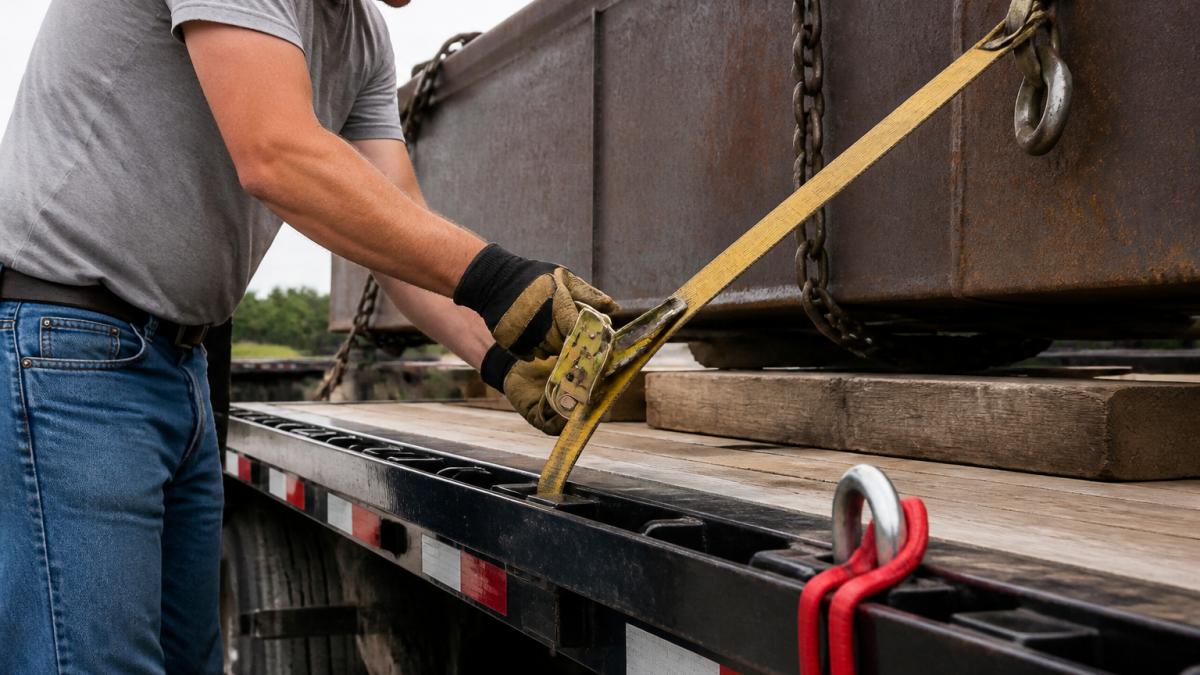
Step 4: Attach the first hook. Tools like StrapEaze hold flat, double J, or S hooks in place while securing a load. Solo haulers can find practical tips in Extra Set of Hands for Solo Construction Work. How To Videos demonstrate the process visually.
Inspecting and Replacing Securement Gear Before Every Haul
Run through this checklist:
NHTSA cargo securement resources reminds drivers that unsecured loads are a real road hazard. The check takes minutes. The consequences of skipping it last far longer.
Add StrapEaze to Your Securement Kit
StrapEaze was built to simplify securing loads. Our magnetic hook holder uses two neodymium magnets, each with a 6 lb. pull rate, to hold flat, double J, or S hooks in place while securing a load. It gives you that extra set of hands and helps eliminate the need to go back and forth across the trailer.
Here is what that means on a real haul:
- Holds flat, double J, or S hooks in place while securing a load
- Works with the hooks you already own, including flat, double J, and S styles
- Made in the USA from flexible, durable red rubber
Add StrapEaze to your securement kit.
Frequently Asked Questions
Are bungee cords safe for securing heavy cargo?
No. Bungee cords are designed for light loads like tarps, garden tools, and small bundles. They stretch under tension and can snap loose when a heavy load shifts, sending the hook flying. For anything heavy, use a rated ratchet strap or chain with a working load limit that exceeds the cargo weight, and check the rating label before you haul.
Can bungee cords break under heavy loads?
Yes. A bungee cord's elasticity works against it here: the more you stretch it, the more stored energy it holds, and a hook that slips or a cord that snaps releases that energy as recoil. That snapback can hit a person or crack a window. UV exposure and fraying weaken the rubber over time, so an old cord can fail well below its original strength.
What is the working load limit for a bungee cord?
Most bungee cords are not sold with a working load limit at all, and that is the core problem. A working load limit is the maximum weight a rated securement device is designed to hold in service, typically a fraction of its breaking strength. Without a printed rating, you have no way to confirm a cord can hold a given load, which is why heavy cargo should go on straps with a stamped WLL.
Are ratchet straps safer than bungee cords for heavy cargo?
Yes. Ratchet straps for heavy loads carry a stamped working load limit, lock tension in place with a ratchet mechanism, and do not rely on stretch to hold. That means the load stays put even when it shifts. Match the strap's WLL to the cargo weight, use at least two straps on long items, and attach hooks to solid anchor points rather than thin sheet metal.
How do you secure heavy cargo in a trailer?
Start by checking the cargo weight against your strap ratings, then position the load low and centered over the axles. Attach hooks to rated anchor points, route straps over the strongest part of the load, and ratchet until the strap is tight with no slack. Add a second strap for long or tall items, then stop and recheck tension after the first few miles. A hook holder like StrapEaze keeps hooks in place while you tighten one-handed.
